Ideal Weight Chart & Calculator
This Page (contents):
Our ideal weight chart includes many of the most common formulas and methods for calculating ideal weight. If you are interested in losing weight, you can use the weight zones shown in our charts (based on your BMI or Body Mass Index) as a guide for choosing your target weight. But, keep in mind that there are many different methods for estimating your ideal weight, and many factors besides height and gender that ought to be taken into account, such as frame size, age, and muscle tone.
You may also want to check out our new Weight Loss Charts or BMI chart.
Many of the ideal weight charts you will find on the internet do not list what formulas they are using to create the weight chart. Our charts and calculator come with full disclosure, either because we tell you what formulas we are using, or you can find out for yourself by looking at the formulas in the spreadsheet.
Ideal Weight Calculator
Choose your gender and enter your height in the fields below to calculate an ideal weight range based on different formulas.
Ideal Weight Calculator
Important: This calculator does not take into account age, frame size, muscle tone, etc. The BMI-based weight ranges are not designed for children. See the ideal weight formula section below for more information about the formulas used in this calculator.
Download Ideal Weight Charts in PDF Format


Download the Ideal Weight Charts in PDF format.
Ideal Weight Chart and Calculator
for Excel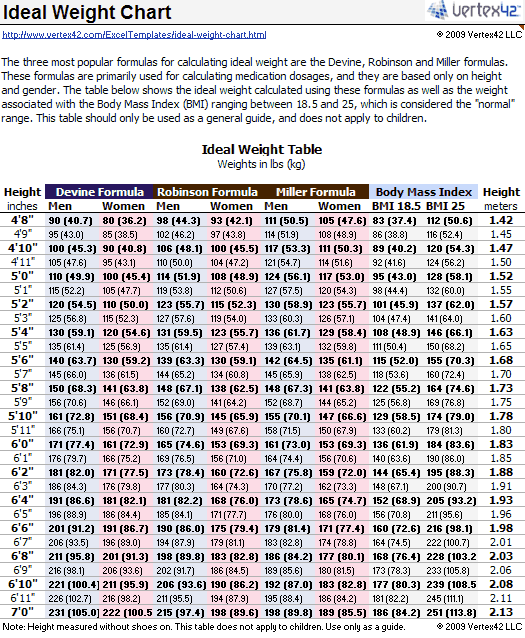
Download
⤓ Excel (.xlsx)License: Personal Use (not for distribution or resale)
"No installation, no macros - just a simple spreadsheet" - by Jon Wittwer
Description
This spreadsheet contains a table, ideal weight charts, and a calculator for finding your ideal weight, using either the Devine, Robinson, or Miller formulas. It also includes the "normal" weight zones associated with the standard BMI range 18.5-25.
Ideal Weight Chart Formulas
The three most popular formulas for calculating ideal weight are the Devine, Miller and Robinson formulas[3]. The above weight charts and the spreadsheet includes all of these formulas so you can see the differences. They are primarily used for calculating medication dosages, and they don't account for age, frame size, muscle tone, etc. See the references below for more information about these formulas.
Another method for finding a range for your ideal weight is to use the "Normal Weight" range determined by the standard Body Mass Index range of 18.5 - 25 [1]. The body mass index is only based on height and is calculated the same both both men and women. You can use our online BMI Calculator, but the one included in the spreadsheet also includes the Devine, Robinson, and Miller formulas. It is important to note that BMI for children is not calculated the same way as for adults.
In the Ideal Weight Calculator included in the above spreadsheet, you will find two separate tables defining what BMI value is used to define Overweight. The standard value defined by the CDC[1] is 25 for both Men and Women. I prefer to use the NHANES II[2] definition which defines Marginally Overweight as over 26.4 for Men and over 25.8 for Women.
https://www.halls.md/ideal-weight/body.htm
Summary of Ideal Weight Formulas
Listed below are the formulas we used to calculate weight in pounds W[lb] given height in inches H[in]. Multiple the weight in pounds by 0.45359237 to get weight in kilograms.
- BMI Formula
W[lb] = ( BMI * H[in]^2 ) / 703 - Devine Formula
Men: W[lb] = 110 + 5.06 * ( H[in]-60 )
Women: W[lb] = 100.1 + 5.06 * ( H[in]-60 ) - Robinson Formula
Men: W[lb] = 114.4 + 4.18*(H[in]-60)
Women: W[lb] = 107.8 + 3.74*(H[in]-60) - Miller Formula
Men: W[lb] = 123.64 + 3.10*(H[in]-60)
Women: W[lb] = 116.82 + 2.99*(H[in]-60)
References
- [1] Body Mass Index (BMI) at cdc.gov - Definitions for BMI categories according to the CDC.
- [2] Overweight at halls.md - Includes the BMI table from the NHANES II survey (USA 1976-1980).
- [3] Ideal Weight Formulas at wellness.com - A summary and brief history of ideal weight calculations
- Ideal Body Weight at halls.md - Calculations and formulas for ideal weight.
Disclaimer: This spreadsheet and the information on this page is for general illustrative and educational purposes only. For medical advice, please consult a qualified medical professional.